A brain signal can help a person move a robot, but it does not give the robot a human mind. The useful systems pair brain sensing with software, cameras, and safety limits, which makes the next stage of robotics a control problem rather than a science-fiction trick.
- Brain signals can guide a robot without direct muscle movement.
- EEG, EMG, cameras, and touch sensors can work as one control system.
- The hard limit is reliability during normal work, not a lab demonstration.
How the control link works
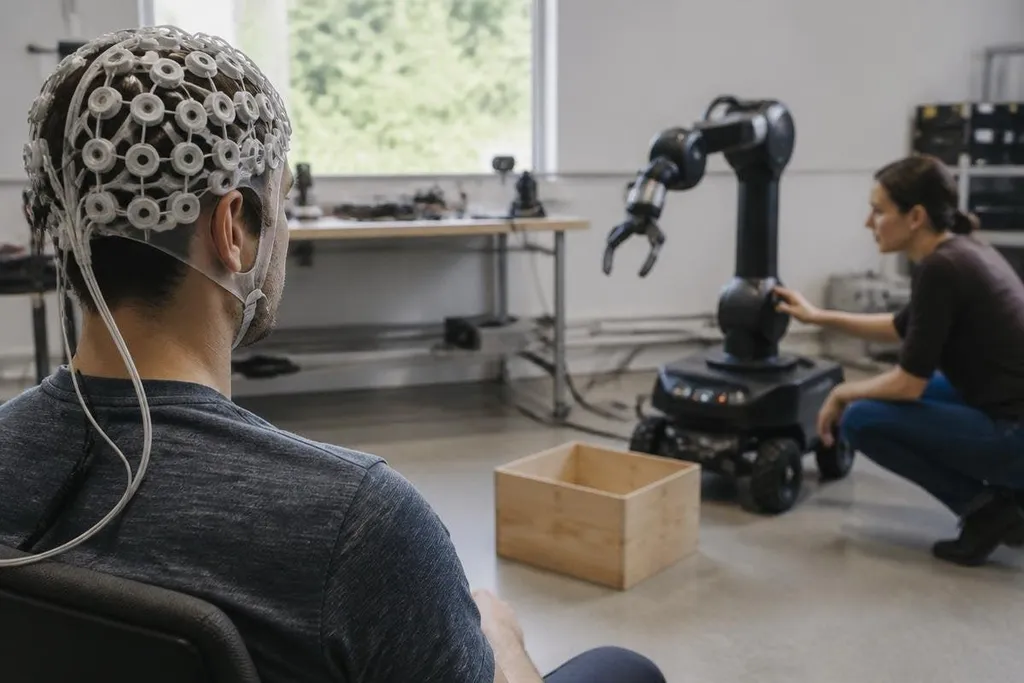
Most brain-controlled robots start with an electroencephalogram, or EEG. A set of sensors measures electrical activity near the scalp, then software looks for patterns linked to a person’s intent, such as choosing left instead of right.
That signal is noisy. Movement, blinking, loose sensors, and electrical interference can change the reading. The software must sort a useful command from all the other activity before the robot moves.
A second route uses muscle signals. Electromyography, or EMG, measures electrical activity in muscles. A robotic arm could read a small wrist or finger signal even when the user has little movement, then turn that signal into a hand or arm command.
These systems do not need to read private thoughts. They usually detect a trained signal linked to a known choice. That difference matters because it sets a clear limit: the robot responds to a control pattern, not a full sentence inside someone’s head.
Why one signal is not enough
A robot working near people needs more than a command from the user. Cameras can check where objects are. Force sensors can detect contact.
Joint sensors can report the arm’s position, while software can slow or stop movement when the command conflicts with the robot’s surroundings.
This shared control reduces the work placed on the person. The user might select an object or direction, while the robot handles the arm path and avoids a table edge. The arrangement is closer to giving a robot a target than steering each motor by hand.
The same idea can help people with limited movement control assistive devices, wheelchairs, or prosthetic limbs. It may also help remote operators guide robots through places that are unsafe for people, though any delay or bad sensor reading can still cause trouble.
The real test is whether a brain signal stays accurate when the user moves, tires, or faces noise from other sensors. Brain-computer robotics reporting from Robot24.com can tie that claim to the device, task, test group, and error rate.
The limits that decide whether it works
Accuracy is only one measure. A system also needs low delay, stable signals, and a setup that a person can wear for long periods. A control method that works for a short trial may become tiring when the user must repeat the same task for hours.
Training adds another cost. The person may need to repeat commands so the software can learn their signals. If the system needs frequent retraining, it becomes harder to use outside a lab or clinic.
Safety creates a separate test. A wrong command should not send an arm toward a person, drop a load, or move a wheelchair near a ledge. The robot needs local rules that can reject unsafe movement, even when the user gives a clear signal.
Privacy also matters. Brain and muscle signals can reveal information about health, fatigue, and movement. Any system that stores those signals needs clear rules for access, deletion, and consent.
A practical buying and testing guide
Before choosing a mind-controlled robot or control kit, check these points:
- Signal type: Confirm whether it reads EEG, EMG, eye movement, voice, or a mix.
- Command range: Count the actions the user can select without switching modes.
- Response delay: Test the time between the signal and the robot’s movement.
- Failure behavior: Check whether the robot stops when the signal becomes unclear.
- Setup time: Measure how long sensor placement and user training take.
- Data handling: Ask where raw signals are stored and who can access them.
A larger command set can sound useful, but it may also raise error rates and training time. For many tasks, a few clear commands paired with automatic obstacle checks will work better than full manual control.
I'd wait for repeated tests with independent users before paying for a system aimed at daily work. The open question is whether these interfaces can remain accurate and comfortable after the novelty has gone.
The next useful proof will be a robot completing the same task across long sessions, with published error rates, response delay, sensor setup time, and safe-stop results.